
How to Get Court Records
Know the court before you ask for a Humphreys County file. The Circuit Court Clerk holds Circuit civil and criminal material and handles General Sessions contact. The Clerk & Master keeps the Chancery dockets, minutes, and related records. Local rules send probate to the County Clerk. A municipal citation stays with the city clerk unless the case moved to another court.
Humphreys County offers no countywide trial-record portal or request form. Call the clerk. Inspect the file at the counter. Send a focused written or mailed request, or ask for an electronic copy if the office provides one. Tennessee Public Case History can help you spot an appealed matter. It serves appellate cases only. Before you travel or mail anything, ask about a public terminal, paper index, scanner, appointment, delivery method, and advance payment.
- Name the court, division, case number, and filing year.
- Identify the exact docket, pleading, order, minute, or judgment.
- Choose inspection, plain paper, electronic, mailed, or certified copy.
- Ask for a price and expected response before authorizing copies.
- Request the public portion and the authority for any withheld material.
Humphreys Court Records Custodians
Split custody is the main local obstacle. The Circuit Clerk route runs through Room 106 at the Waverly courthouse. The Clerk & Master sits in Room 202. Probate falls to the County Clerk under the 23rd Judicial District's special arrangement. The county page lists many non-court services too. Waverly, McEwen, and New Johnsonville each keep separate municipal routes.
| Record | First office | Useful identifier |
|---|---|---|
| Circuit or Sessions file | Circuit Court Clerk | Case number, name, year, type |
| Chancery file | Clerk & Master | Chancery number, style, category |
| Probate matter | County Clerk first | Estate name, year, index |
| Municipal case | Issuing city clerk | Citation, date, city |
A referral is only routing evidence. It does not mean your first request went to the wrong place. Write down the new office, the record series, the contact, and the referral date, which helps most with an older probate file or a matter appealed from Sessions.
Types of Court Records
The docket is just the index layer. Beneath it sit the pleadings: complaints, petitions, answers, responses, and amendments. Process records cover summonses, subpoenas, returns, and service affidavits. Motions, briefs, exhibits, proposed orders, signed orders, and judgments form another layer. Hearings can generate minutes, electronic recordings, reporter notes, or transcripts.
Financial entries may list costs, fines, restitution, bonds, payments, or satisfaction where the clerk maintains them. Treat them as leads, not a complete ledger. Tennessee Supreme Court Rule 34 also separates case records from administrative and judicial records. Those categories do not always share one access route.
- Docket or chronological register
- Filed pleadings and service papers
- Motions, exhibits, orders, and judgments
- Minutes, recordings, and transcripts
- Cost, payment, or satisfaction records where maintained
Five Humphreys Court Record Layers
A single docket line can point to more than one thing. "Motion filed" names both an index entry and a real paper in the court file. "Hearing held" might point to a minute entry, an official recording, and a reporter's transcript. "Order entered" can cover a short docket label as well as the signed order itself. Name each object when you request it. That beats a vague demand for the whole Humphreys County file.
The docket line alone will not tell you what the judge decided. A minute entry is not a transcript. An exhibit may sit in separate storage or carry access limits. A picture saved from a court website is not a certified record. Keeping these layers straight ties your copy request to the actual question you need answered.
- Docket
- Chronological index of case actions.
- Minute
- Concise court record of an event, not verbatim testimony.
- Transcript
- Reporter-created text of proceedings.
- Certified copy
- A copy authenticated by the proper custodian.
What a Court Record Contains
A Humphreys County court record can show many fields. These include the caption, court, division, case number, filing date, case type, parties' procedural roles, counsel, service events, settings, rulings, and disposition. Every field needs context, though. A filing date is not the date of the underlying dispute. A setting may later be reset. A dismissal label does not capture all the terms of the signed order.
| Caption and number | The indexed style and stable case identifier. |
|---|---|
| Filed papers | Pleadings, motions, responses, notices, and exhibits. |
| Settings | Date, time, type, division, judge, and status when recorded. |
| Rulings | Orders, judgments, dismissals, and later corrections. |
| Access status | Public, redacted, sealed, unavailable, or separately held. |
Always check for amended orders, corrected dates, later appeals, and missing attachments. Note whether your source was a docket line, a document, a minute, a transcript, a report, or a clerk response.
Humphreys Electronic Court Records
Tennessee Rule of Civil Procedure 5B allows electronic filing only where the court has adopted a qualifying system. Humphreys County posts no public trial-court e-filing image portal. A statewide rule never guarantees you can view or download a local case file online.
The official Tennessee Rule 5B page sets out the local-adoption condition and the e-filing terms.
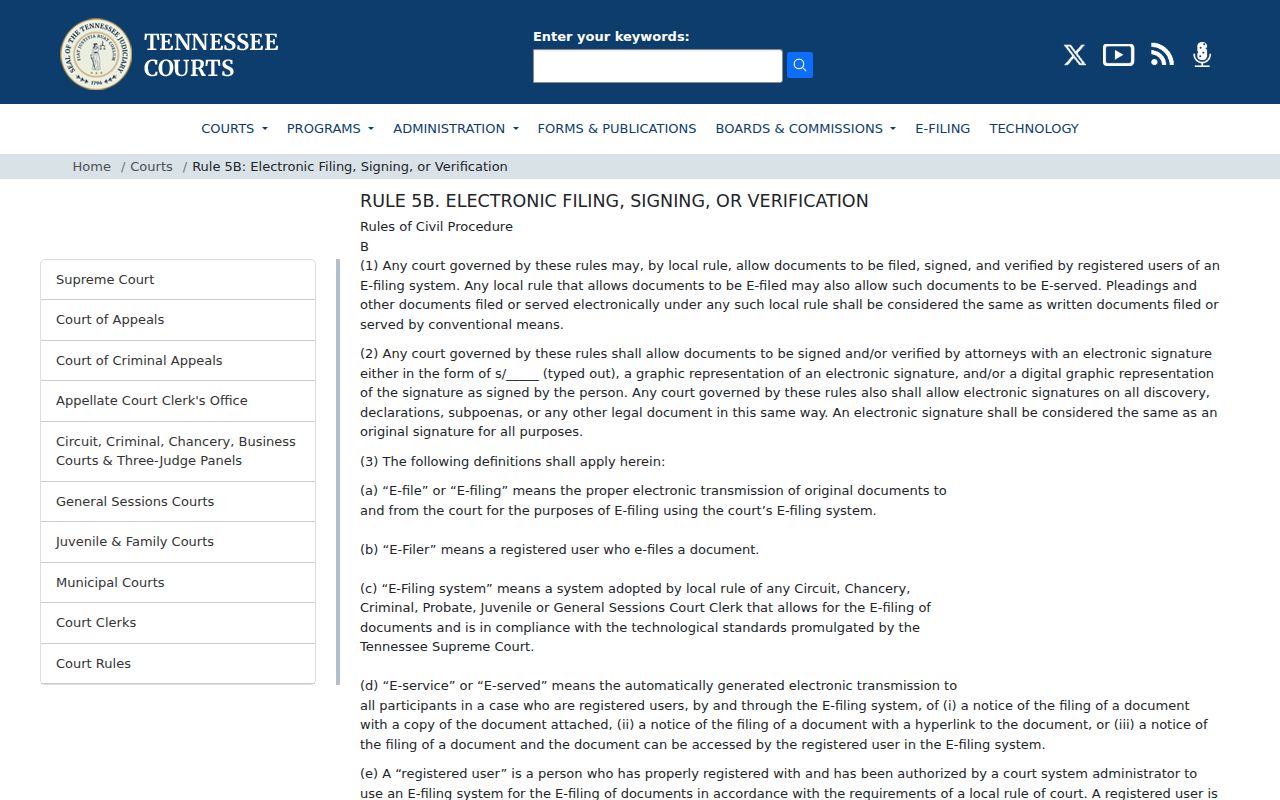
The rule points to one careful question for the clerk: was the record you want e-filed, scanned, printable, or available only for counter inspection?
Certified Copies and Fees
Ask for certification in plain terms. Tennessee Rule of Evidence 902 treats qualifying certified public records as self-authenticating. But a clerk printout or an image pulled from a court website is not certified on its own. So ask specific questions. Who certifies it? Does it come with a seal or a certificate page? Can the office certify a docket extract, or only the underlying order?
The Humphreys County clerk posts no fee card. Nothing covers plain copies, scans, searches, mail, traffic dispositions, or certification. Do not assume an AOC appellate fee applies locally. State guidance lists some specialized amounts. But the clerk must confirm what applies in Humphreys County before any work begins.
| Item | Published guidance |
|---|---|
| Plain or certified local copy | Ask the correct Humphreys clerk for a quote |
| Reporter transcription | State FAQ gives $4 per page as a standard |
| Additional transcript copy | State FAQ gives $0.50 per page |
| Simultaneous official recording duplicate | Rule 26 states $50 in its stated context |
| Later official recording duplicate | Rule 26 states $100 in its stated context |
Note: Confirm whether each statewide amount applies to the specific Humphreys event, custodian, medium, and copy before paying.
Historic Humphreys Court Records
Older Humphreys County court records live in archives. The Humphreys County finding aid at the Tennessee State Library and Archives maps what exists. It lists county clerk, probate, municipal, and revenue-docket series. McEwen and New Johnsonville municipal minutes appear there, along with Waverly minutes and ordinances. Treat the guide as a map to where records sit. It does not promise that every year has been digitized.
When you send a historical request, be specific. Name the jurisdiction, the date span, the record series, and the copy type you want. Then ask the active clerk a direct question. Did the material stay on site, move to an archive, or survive only on microfilm? Retention schedules, transfer dates, scanning coverage, and historic search fees are not published. Confirm those details directly with the office.
Archive transfer is not destruction. A record missing from the active clerk system may survive in a separate series or repository.
Public Access and Sealed Records
Tennessee Supreme Court Rule 34 sets the ground rules for public access to court records. It lets courts use reasonable procedures. Those procedures protect both the integrity of a file and any confidential material inside it. Tennessee's public-record statute opens the door more broadly. Still, specific statutes, rules, and court orders can close off parts of a file. So a Humphreys County docket may mix open and restricted entries. Civil sealing follows Rule 1A standards, while juvenile files carry their own statutory limits.
The official Rule 34 page lays out its definitions and its rules for confidential records.
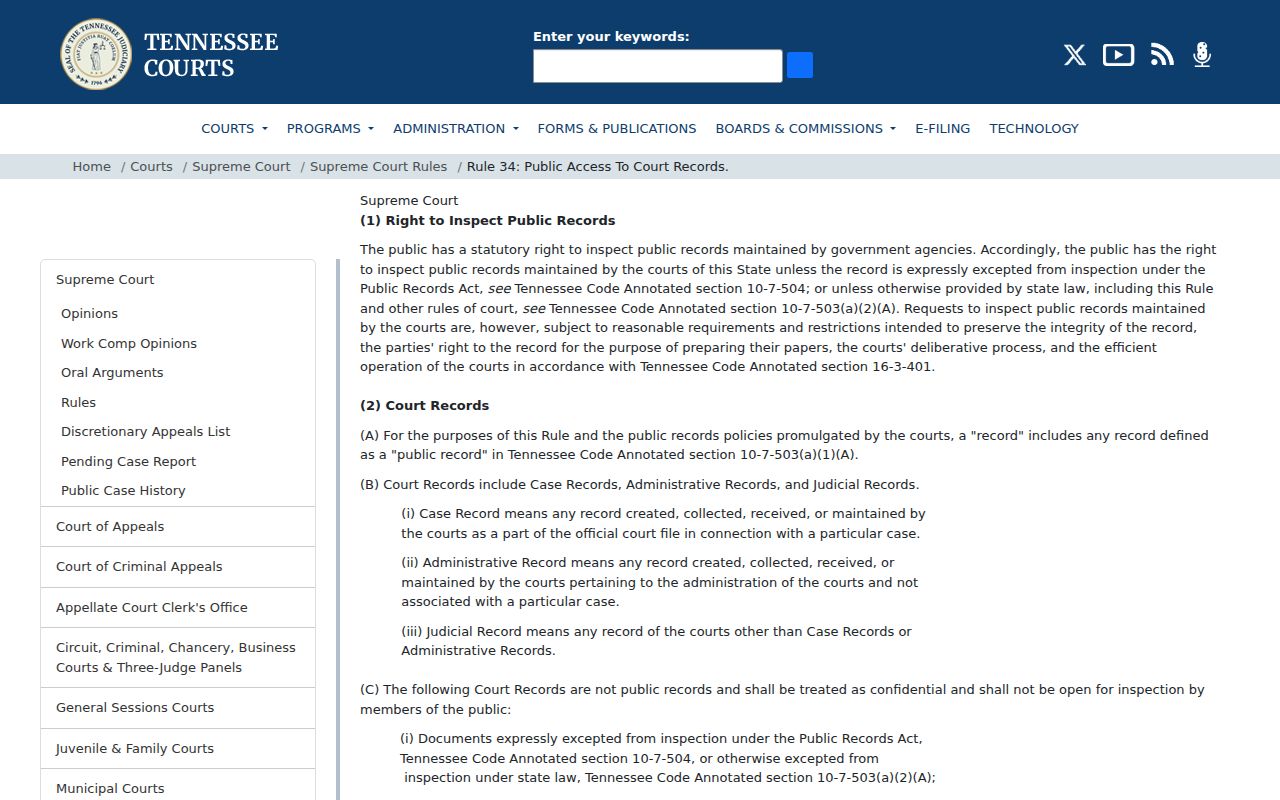
The smart move is a narrow request for the public portion of the Humphreys County court docket, not a push for protected content. If the clerk redacts or denies, ask which statute, rule, or order supplies the authority.
Public inspection does not make every filed identifier safe to republish. Leave out full birth dates, account numbers, minor names, protected addresses, medical details, and sealed content.
Circuit Court Clerk
100 North Court Square, Room 106
Waverly, TN 37185
931-296-2461
Clerk & Master
100 North Court Square, Room 202
Waverly, TN 37185
931-296-2558
michael.bullion@tncourts.gov
Request Humphreys Court Records Precisely
Ask for the smallest record that answers your question. "The docket and final order in case [number]" works far better. A blanket demand for everything tied to a name invites delay. Want a hearing? Request the minute entry, and ask whether an official recording or transcript exists. For an order, give its docket date. Say whether you want a plain or certified copy.
Clerks are not required to build a new person-by-person report from unrelated docket entries. No such report exists, and the duty stops there. For historical totals, the existing AOC aggregate tables fit better. For an individual register and case file, the local clerk is the right office. Keep your request and the response, and note any cost estimate. When the case number is unknown, start with the Humphreys County case search.
- Court, division, case number, and style
- Exact document and entry date
- Inspection, plain copy, scan, or certification
- Acceptable redaction of protected content
- Mailing and payment instructions